




How to Optimise Your Website for Voice Search
“Hey Google, find a coffee shop near me.” Searches like this are now part of daily life, spoken into phones, smart speakers and watches millions of times a day. For businesses, that shift changes the rules of being found online. Learning how to optimise your website for voice search is no longer a futuristic nice-to-have — it is a practical way to capture customers who are increasingly talking to their devices rather than typing.
This guide explains how voice search differs from traditional search, why it matters for your business, and the concrete steps you can take to make sure your website is the one the assistants choose to read aloud. The good news is that optimising for voice also strengthens your overall SEO, so the effort pays off twice.
How Voice Search Is Different
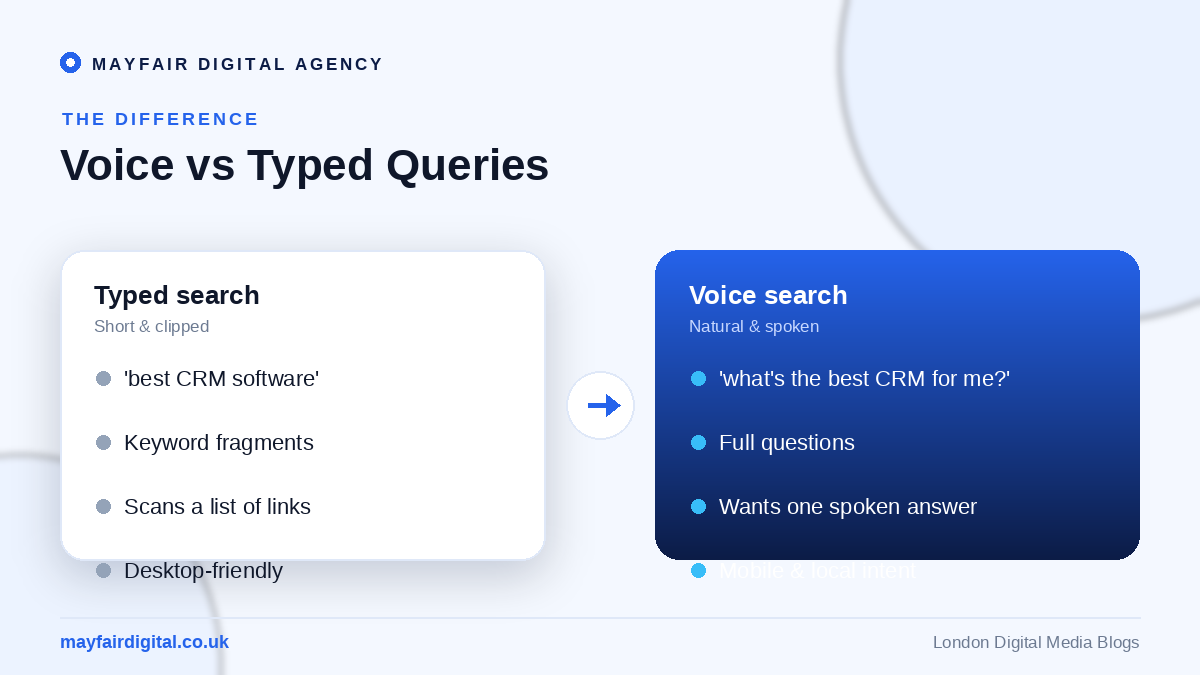
When people type, they use short, clipped phrases like “best CRM software”. When they speak, they use natural, conversational language and full questions, such as “what is the best CRM software for a small business?”. Voice queries are longer, more specific and almost always framed as questions. Optimising for voice therefore means anticipating the real questions your customers ask out loud.
Voice searches are also overwhelmingly intent-driven and frequently local. People ask their assistant to find, call or get directions to a business right now. That makes voice traffic some of the most valuable there is, because the searcher is usually ready to act immediately rather than merely researching.
Finally, voice search typically returns a single spoken answer rather than a page of blue links. The assistant reads out one result — often drawn from a featured snippet. This “winner-takes-all” dynamic raises the stakes: being the chosen answer is enormously valuable, while ranking second for a voice query may mean being invisible.
Why Voice Search Matters for Your Business
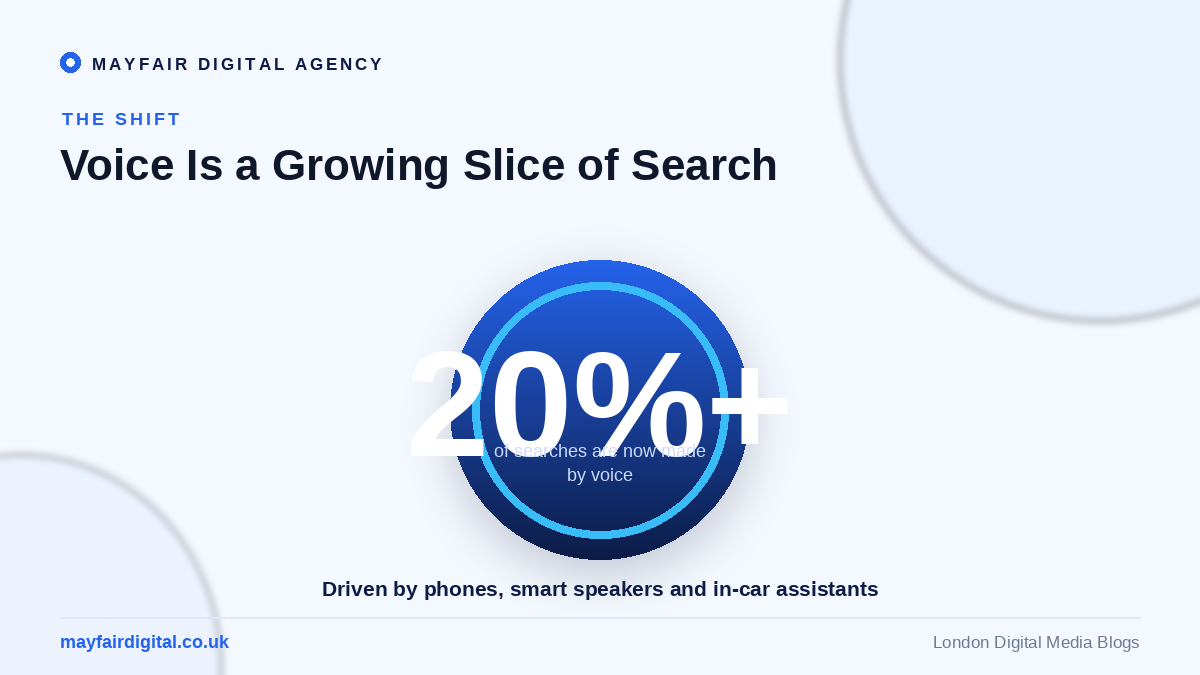
Voice usage has grown rapidly alongside smartphones and smart speakers, and it continues to climb. Ignoring it means missing a fast-growing slice of potential customers, particularly for local businesses where “near me” voice searches drive real footfall and phone calls. Getting ahead now positions you to capture that demand before competitors do.
There is a compounding benefit, too. The work that makes a site voice-friendly — clear answers, fast loading, strong local signals and structured data — also improves traditional rankings and the overall user experience. Optimising for voice is rarely wasted effort; it tends to lift your entire search presence.
Target Conversational, Question-Based Keywords
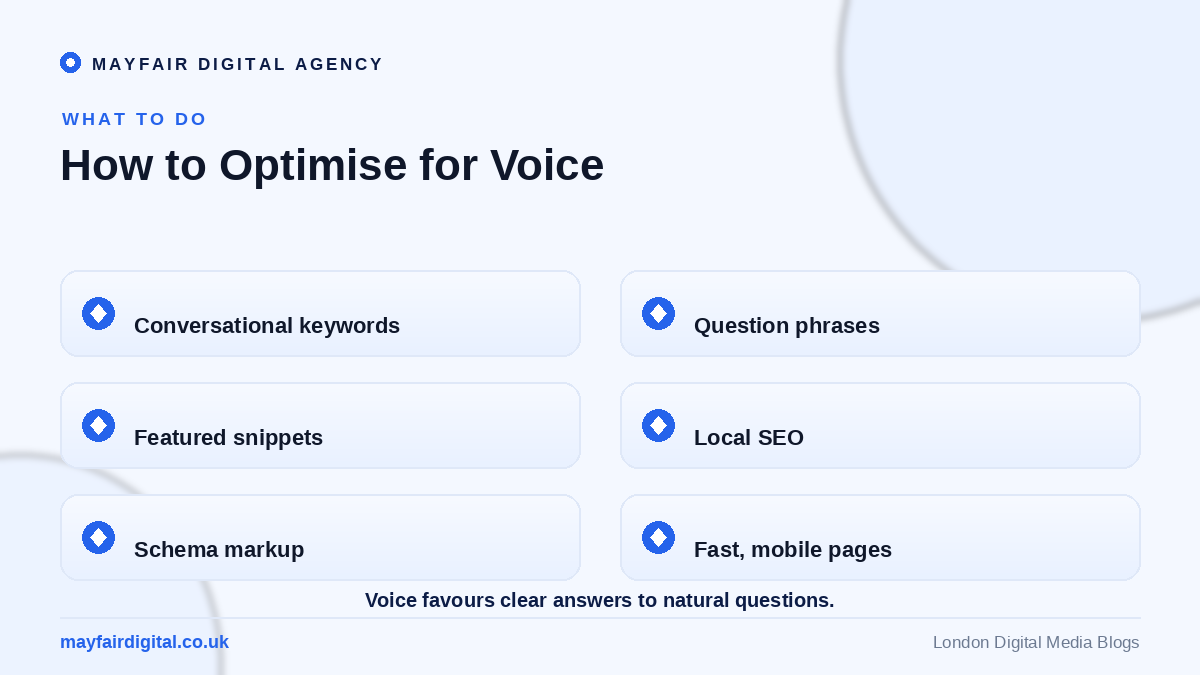
Because people speak in questions, your content should answer them directly. Research the who, what, where, when, why and how questions your customers ask, and build content that responds clearly and concisely. Long-tail, conversational phrases that mirror natural speech are the foundation of voice optimisation.
A frequently asked questions section is one of the most effective tools here. By posing the exact question a customer might speak and answering it in a sentence or two, you hand assistants a ready-made response to read aloud, dramatically improving your chances of being selected.
Win the Featured Snippet
Voice assistants frequently pull their spoken answer from the featured snippet — the boxed result at the top of Google. To earn it, answer the question directly and succinctly near the top of your content, ideally in around forty to fifty words, then expand with detail below. Clear structure with descriptive headings makes it easy for search engines to extract your answer.
Formatting matters as much as wording. Concise paragraphs, ordered steps for “how to” queries and clean lists all help search engines understand and lift your content. Writing with the snippet in mind is one of the highest-impact things you can do for voice visibility.
Prioritise Local SEO
Since so many voice searches are local, a complete and accurate Google Business Profile is essential. Ensure your name, address, phone number, opening hours and categories are correct and consistent everywhere they appear online. Encourage reviews, add photos and keep the profile active — these signals strongly influence which business an assistant recommends.
Consistency across directories and your own website reinforces trust. When every source agrees on your details, assistants can confidently serve your business as the answer to “where is the nearest…” style questions.
Make Your Site Fast and Mobile-Friendly
Voice searches happen mostly on mobile devices, and assistants favour pages that load quickly and display well on small screens. A slow or clunky mobile site will rarely be chosen, no matter how good the content. Optimise images, streamline code and ensure your design is fully responsive so that speed never costs you the answer slot.
Add Structured Data
Structured data, or schema markup, is code that helps search engines understand exactly what your content means — a price, a review, an address, an FAQ. While invisible to visitors, it gives assistants the context they need to use your information confidently in spoken results. Implementing relevant schema is a technical but high-value step in voice optimisation.
Frequently Asked Questions
Is voice search really worth optimising for? Yes. Voice usage is growing fast and skews toward high-intent, local queries. Optimising for it also improves your traditional SEO, so the benefits extend well beyond voice itself.
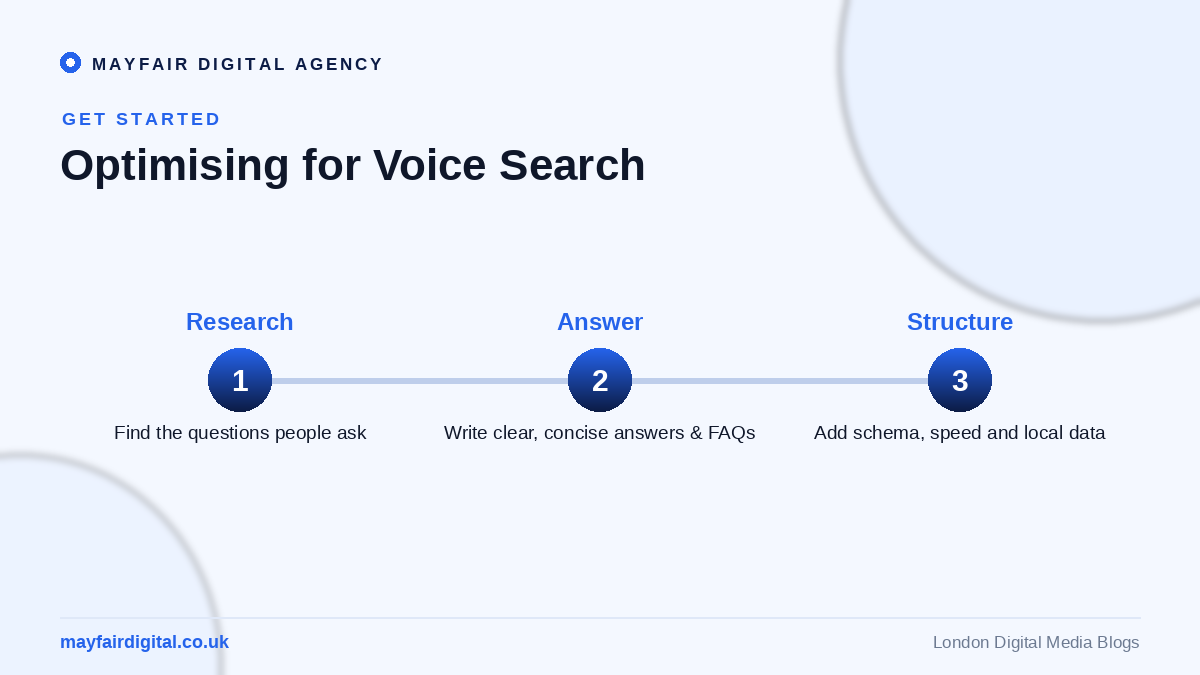
How do I rank for voice search? Target conversational questions, answer them concisely to win featured snippets, strengthen local SEO, speed up your mobile site and add structured data.
Does voice search optimisation help normal Google rankings? Absolutely. The same factors — clear answers, speed, structure and authority — drive both, making voice optimisation a smart all-round investment.
Get Found by Voice With Mayfair Digital Agency
Voice search is reshaping how customers find businesses, and the ones optimised for it will capture the spoken answers their competitors miss. As a full-service digital media agency, Mayfair Digital Agency helps businesses optimise their websites for voice and traditional search alike — combining technical SEO, content and local optimisation. If you want to be the answer customers hear, get in touch and let’s make your site voice-ready.
Getting Started With voice search optimisation
Putting all of this into practice does not have to be overwhelming. The most effective approach to voice search optimisation is to begin with a clear goal, get the fundamentals right first, and improve steadily based on real results rather than guesswork. Small, consistent steps compound into significant gains over time, and a deliberate plan will always outperform sporadic bursts of effort.
It also helps to review your progress regularly. By tracking the metrics that genuinely matter to your business and adjusting course when the data points the way, you keep voice search optimisation working as an engine for growth rather than a box-ticking exercise. The brands that win are the ones that treat this as an ongoing discipline, not a one-off task to be completed and forgotten.
And if you would rather focus on running your business while experts handle the detail, that is exactly where a specialist partner earns its keep. As a full-service digital media agency, Mayfair Digital Agency helps businesses get real, measurable results from voice search optimisation — combining strategy, creativity and data so every effort drives toward growth. Get in touch and let’s build something that lasts.
The Future of Search Is Conversational
Voice is part of a wider move toward conversational, intent-led search that now includes AI assistants and chat-based tools. The businesses that prepare by answering real questions clearly, structuring their content well and earning trust will be the ones surfaced across all of these interfaces, not just classic search. Optimising for voice today is really an investment in being discoverable however your customers choose to ask tomorrow.
Start small and build momentum: add an FAQ section, rewrite a few key pages to answer questions directly, tidy up your local listings and check your mobile speed. Each improvement nudges you closer to owning the spoken answer, and together they compound into a meaningful advantage as voice search continues its steady climb.
Need expert help? Mayfair Digital Agency is a digital agency in London and full-service digital agency in London offering global SEO agency and more. Get in touch for a free consultation.


