




The AI Advertising Revolution: A Paradigm Shift in February 2026
AI advertising reached a turning point in early 2026. Within a single month, conversational ads arrived inside ChatGPT, Meta switched on global advertising across Threads, and Google began placing sponsored offers directly inside AI Mode. For brands and agencies, the question is no longer whether AI will reshape advertising — it already has.
This is the “Great Transition”: away from passive search results and manual campaigns, towards conversational commerce, generative creative and Generative Engine Optimisation (GEO). Here is what changed, why it matters, and how to adapt.
ChatGPT Ads: Conversational Monetisation Arrives
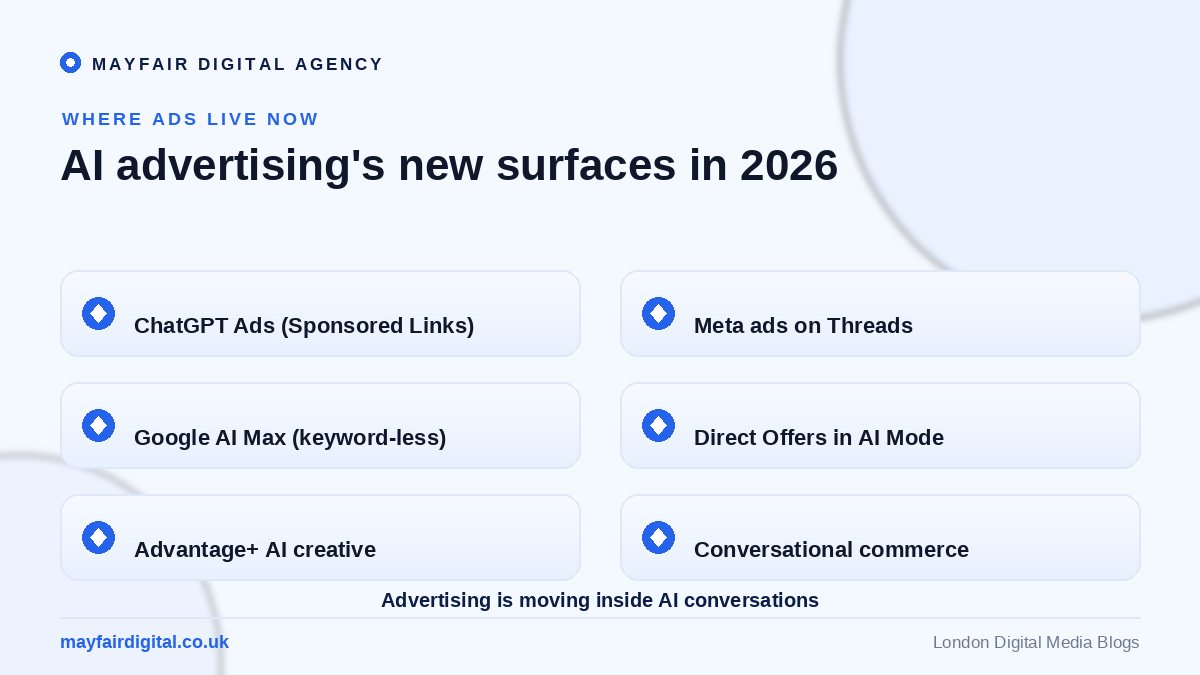
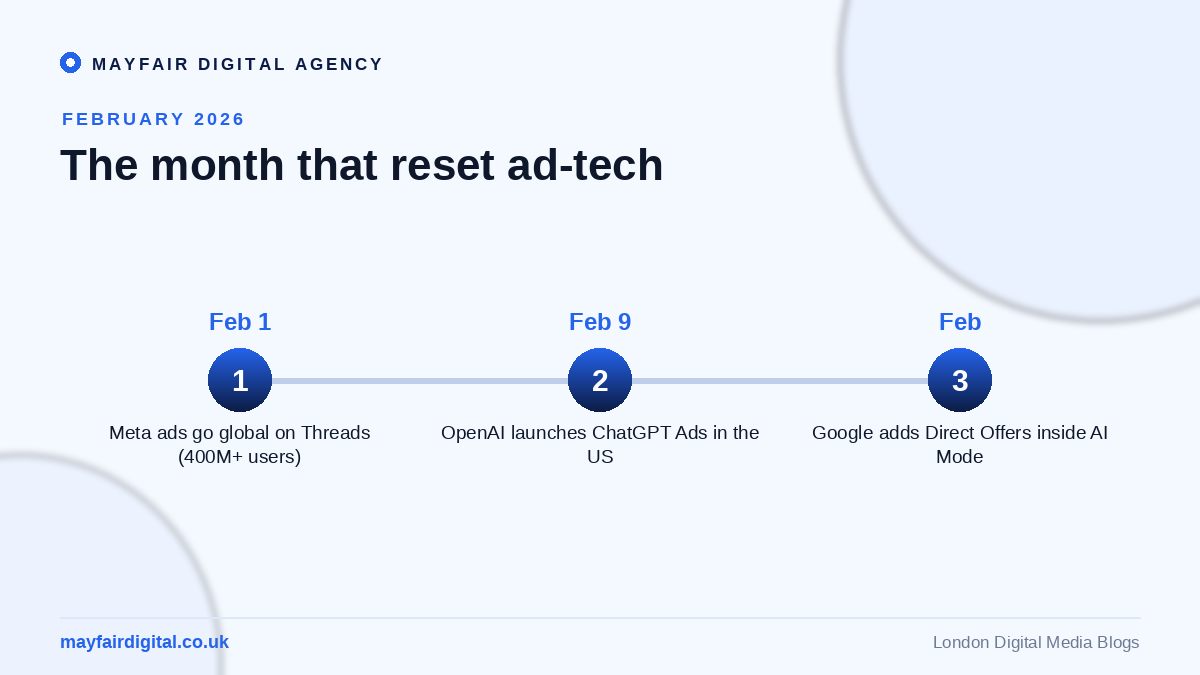
On 9 February 2026, OpenAI began a limited rollout of ChatGPT Ads. Rather than cluttered banners, these are discreet “Sponsored Links” shown at the bottom of AI responses for logged-in US adults on the Free and Go tiers. OpenAI reportedly set a premium entry barrier of around $200,000 for early advertisers. As one London media buyer put it, the model sells relevance at the exact moment a user is seeking a solution — not user data.
Meta, Threads and AI-Generated Creative
In the first week of February 2026, Meta completed the global rollout of ads on Threads, a platform now past 400 million monthly active users. Crucially, Meta’s Advantage+ AI decides which 4:5 video or carousel will resonate in Manchester versus Madrid — and Meta is pushing towards fully automated, end-to-end ad creation, including AI dubbing, AI music and persona-based creative localisation. The advertiser increasingly provides a URL and a budget; the AI does the rest.
Google AI Max and Direct Offers in AI Mode
Google is moving just as fast. Its AI Max campaigns drop keyword targeting entirely, using Gemini to match landing pages to user intent, while February 2026 saw sponsored Direct Offers appear inside AI Mode’s conversational results. For advertisers who built careers on keyword research and match types, this is a genuine paradigm shift — context and intent now matter more than exact-match keywords. We explore the organic side of this in our guide to Google’s AI Search expansion.
Ad Spend Is Shifting to AI Platforms
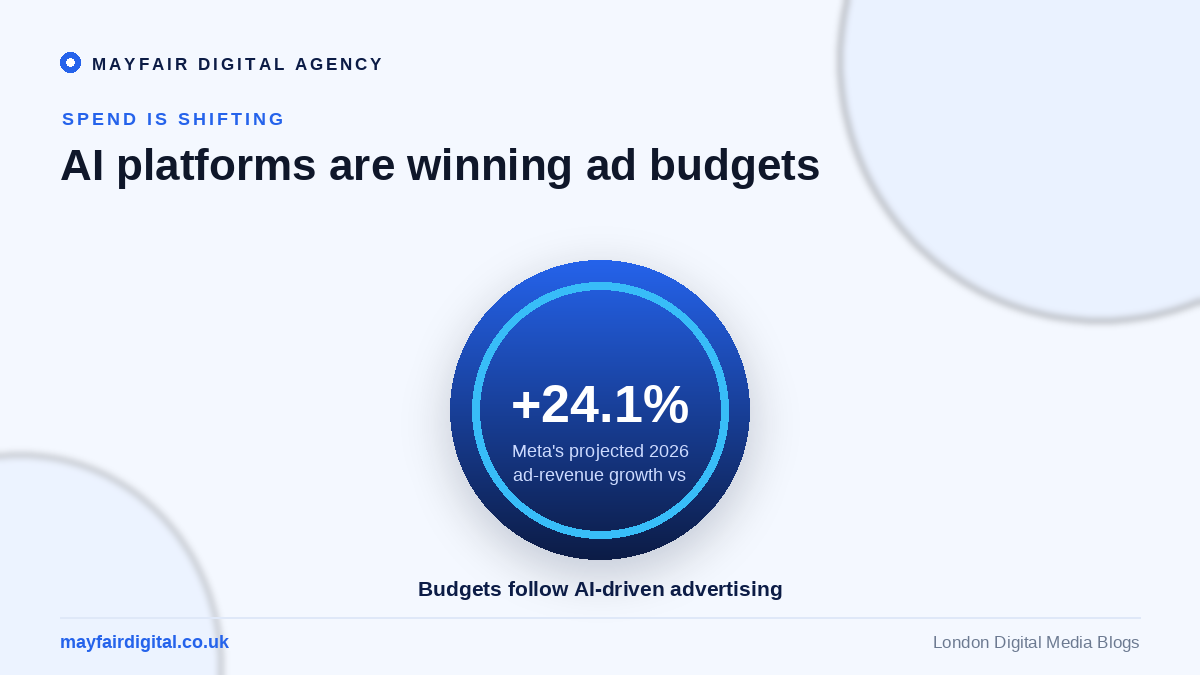
The money is following the technology. eMarketer forecasts Meta will overtake Google in advertising revenue in 2026, with Meta growing roughly 24.1% against Google’s 11.9%. The common thread is automation: platforms that let AI generate, target and optimise campaigns are capturing a growing share of budgets.
Beyond Search: GEO and “Perception Drift”
For the SEO community, 2026 is the year “ranking” gave way to “visibility.” The emerging metric is perception drift — the gap between how a brand wants to be seen and how large language models actually describe it. Winning in this environment means:
- Building verifiable authority (E-E-A-T) that AI engines like Gemini and Perplexity trust.
- Optimising to be the cited “source of truth” in AI answers.
- Mastering structured data and schema so AI crawlers can digest your content.
The Human Cost: From “Doers” to “AI Orchestrators”
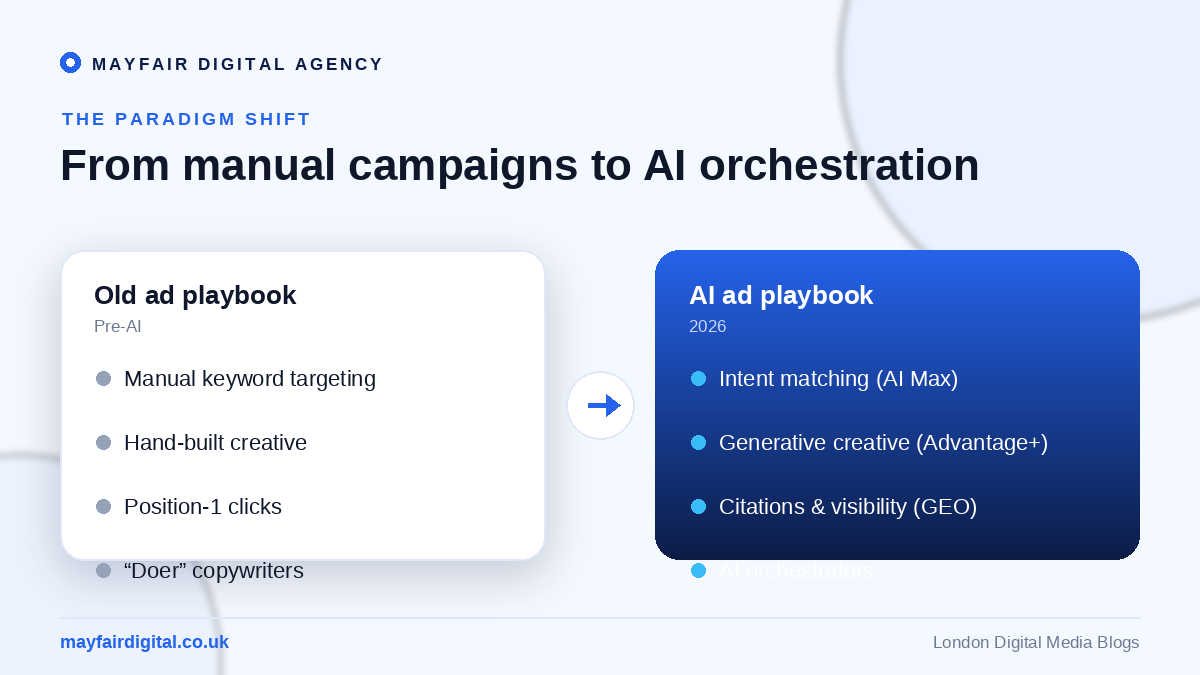
This shift has a human side. Data from the UK’s Institute of Practitioners in Advertising (IPA) points to roughly a 14% decline in agency staff numbers over the past year as AI-driven production becomes the norm. The roles in demand are changing too: agencies now want “AI orchestrators” who can guide generative tools with precision and ethical oversight, rather than purely hands-on “doers.”
How to Adapt to AI Advertising in 2026
- Test the new ad surfaces — ChatGPT Ads, Threads and AI Mode offers — with small, measurable budgets.
- Feed the machines well: strong landing pages, clean feeds and clear creative briefs improve AI targeting.
- Invest in GEO — authoritative, citable content that LLMs surface and trust.
- Upskill your team as AI orchestrators, pairing automation with human judgement.
- Measure AI visibility, not just clicks — see our guide to Search Console’s AI performance reports.
For the bigger picture, see the future of SEO. Google’s own AI Max announcement shows how quickly keyword-based advertising is being replaced by intent-based AI.
Frequently Asked Questions
What is AI advertising?
AI advertising uses artificial intelligence to generate creative, target audiences, place ads and optimise campaigns — including new formats like ChatGPT Ads and Google’s AI Max, which match intent instead of relying only on keywords.
What are ChatGPT Ads?
ChatGPT Ads are sponsored links shown within ChatGPT responses, launched by OpenAI in a limited US rollout on 9 February 2026, designed to surface relevant solutions at the moment of intent.
What is GEO in advertising?
Generative Engine Optimisation (GEO) focuses on getting your brand cited and accurately represented inside AI-generated answers, complementing paid AI advertising with organic AI visibility.
Want help navigating AI advertising and GEO? Talk to Mayfair Digital Agency, or explore our digital marketing services.
What the Shift to AI Advertising Means for Brands
The arrival of advertising inside conversational AI tools and the spread of generative formats represent a fundamental change in how brands reach their audiences. Advertising is moving away from static placements toward dynamic, context-aware experiences embedded in the moments when people are actively asking questions and seeking solutions. For brands, this means rethinking not just where ads appear but how they are conceived, created and optimised for an AI-mediated world.
Crucially, this transition rewards relevance and helpfulness over interruption. As ads become woven into conversational and generative experiences, the brands that succeed will be those whose messages genuinely fit the context and add value, rather than those that simply shout the loudest. Understanding this shift early gives forward-thinking businesses a meaningful advantage.
Generative Engine Optimisation Becomes Essential
As advertising and discovery increasingly happen inside AI systems, optimising to be surfaced by those systems — often called Generative Engine Optimisation — is becoming a core discipline. The principles build on familiar SEO foundations: create clear, authoritative, genuinely useful content, structure it so machines can understand it, and build a trusted brand presence. The difference is that the goal now includes being featured, recommended and cited within AI-generated responses, not only ranking in traditional results.
Businesses that begin adapting to this reality now will be well positioned as these AI-driven channels mature. By thinking about how their products and content might be surfaced in conversational answers and generative experiences, they can capture visibility that competitors focused solely on traditional methods will miss.
How to Adapt Your Strategy
Navigating this new landscape does not mean abandoning what works; it means building on it. Continue investing in quality content, a strong brand and solid SEO, while experimenting with the new advertising and optimisation opportunities AI platforms present. Stay informed about how these formats develop, test thoughtfully, and measure what genuinely drives results for your business rather than chasing novelty for its own sake.
It also helps to keep your messaging clear, honest and genuinely useful, since these qualities translate well across both traditional and AI-driven channels. The brands that combine timeless fundamentals with a willingness to embrace new formats will be best placed to thrive through this transition.
Preparing for Conversational Commerce
The move toward conversational commerce — where discovery, recommendation and purchase increasingly happen within AI-driven conversations — has significant implications for how businesses present themselves online. Clear product information, strong reviews, well-structured content and a trustworthy brand presence all help ensure your offerings can be understood and recommended by AI systems. Preparing your digital presence for this reality is becoming an important part of staying competitive.
Businesses that make their information easy for AI to interpret, and that build genuine trust and authority, will be the ones surfaced when customers ask AI tools for recommendations. This is a natural extension of good digital marketing practice, applied to an emerging and rapidly growing channel.
Embracing the Transition With Confidence
The rapid changes in AI advertising can feel overwhelming, but they also present a genuine opportunity for businesses willing to adapt. As with every major shift in digital marketing, the early movers who understand the new landscape and act thoughtfully stand to gain the most. By staying informed, embracing experimentation and holding fast to the fundamentals of helpful, trustworthy marketing, businesses can turn this paradigm shift into a powerful advantage.
At Mayfair Digital Agency, we help businesses navigate exactly these kinds of transitions, combining proven expertise with a forward-looking approach to emerging channels like AI advertising and generative search. As advertising continues its great transition toward conversational and generative experiences, having a partner who understands both the fundamentals and the future is invaluable. If you want to adapt with confidence and seize the opportunities ahead, get in touch and let’s prepare your brand for the next era of marketing.
Need expert help? Mayfair Digital Agency is a digital marketing agency in London and full-service digital agency in London offering digital strategy agency and more. Get in touch for a free consultation.


